Emergency? Danger to life 999 Faults, working hours 22255 Faults, out of hours 22602

Electricity · Renewable energy

Powering St Helena with wind and sun

Today about one unit in ten comes from our wind turbines and solar panels. The plan is to make it more than eight in ten, starting with a new solar farm and battery at Rifle Range.

Renewable now
9.3%October to December 2025
The aim
80%+Energy Delivery Plan
Where your electricity comes from

90.7% diesel, 9.3% wind and sun

Figures for October to December 2025 (Q3 2025/26), the latest published. Every unit of renewable electricity is diesel we do not have to ship to the island and burn.

Q3 2025/26 Generation by source, October to December 2025Solar 8.3%, wind 1.0%, diesel 90.7%. 9.3% renewable
Year 2024/25 Generation by source, financial year 2024/25Solar 8.0%, wind 2.7%, diesel 89.3%. 10.7% renewable
Solar Wind Diesel Shares of electricity generated. Source: Utility statistics: Q3 2025/26.

Diesel

Power Station, Rupert's Valley

Four diesel generators: three Caterpillar 3516B units of 1.6 MW and one 0.8 MW Caterpillar 3508B, coordinated by SCADA. They keep the island supplied when the wind drops and after dark.

9.58 million kWh generated in 2024/25

Wind

Deadwood Plain

Twelve WES80 two-blade turbines. St Helena's first three turbines arrived in the 1990s; the fleet doubled to twelve in April 2014. Turbine size is limited by what can be shipped, lifted and driven up the island's roads.

292,000 kWh generated in 2024/25

Solar

Rifle Range, Half Tree Hollow, and four rooftops

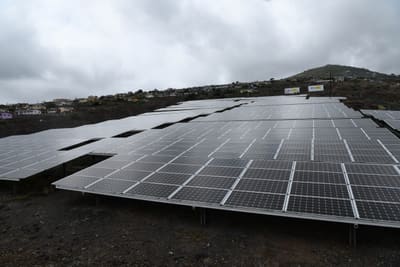
A 500 kWp solar farm at the former rifle range, commissioned in April 2015, plus four small rooftop systems, including our Jamestown offices. Solar produces most when daytime demand is highest.

858,000 kWh generated in 2024/25

In 2024/25 the Power Station used 2.38 million litres of diesel, costing £3.2 million.

Twelve years of renewables

Up to 29%, and back down to 11%

Wind and solar rose quickly after the wind fleet doubled in 2014 and the Rifle Range solar farm opened in 2015, peaking at 28.8% of the island's electricity in 2015/16.

Solar has held steady since, at between 7.5% and 9.2% a year. Wind has not: output has fallen from 2.45 million kWh in 2015/16 to 0.29 million kWh in 2024/25, and diesel now makes up the difference.

The turbines at Deadwood Plain were made by Wind Energy Solutions (WES), which has since gone into liquidation. With no manufacturer behind them, spare parts and specialist support are hard to find. The oldest turbines date from the 1990s, and all of them have spent years in strong, salty winds. As parts wear out, more turbines stand idle for longer while we wait for repairs.

That is why the next step is new, larger renewable plant with storage, rather than more of the same.

Share of the island's electricity from wind and solarRenewable share of electricity by financial year, 2013/14 to 2024/25. It rose to 28.8% in 2015/16 and was 10.7% in 2024/25. The target is more than 80%.0%20%40%60%80%100%Target: more than 80%28.8% peak10.7%13/1416/1719/2022/2324/25
Solar Wind Target
Show the figures
Electricity generated by source each financial year, in kWh, with the renewable share
YearDiesel (kWh)Wind (kWh)Solar (kWh)Renewable
2024/259,580,110291,834857,65510.7%
2023/249,247,736552,323870,56113.3%
2022/238,511,850978,526966,85718.6%
2021/228,548,8221,258,144971,04920.7%
2020/218,198,0571,726,788988,34324.9%
2019/208,965,4141,841,978996,97424.1%
2018/198,943,6452,069,749997,21925.5%
2017/188,708,0381,974,134894,89124.8%
2016/178,490,8162,144,789861,76126.1%
2015/168,038,8752,453,329801,60828.8%
2014/158,619,9892,336,690106,34122.1%
2013/149,593,6361,008,24568,08010.1%
The plan

From one unit in ten to more than eight

Connect's Energy Delivery Plan sets out a pathway to more than 80% of the island's electricity from renewable sources, in three phases.

Phase 1 · Rifle Range, Half Tree Hollow

A new solar farm with battery storage

A ground-mounted solar farm of at least 1.9 MWp and a battery of at least 2 MW / 8 MWh at Rifle Range, integrated with the Power Station, the 11 kV network and SCADA. It is the first of three phases.

The battery stores midday sunshine for the evening and steadies the network when clouds pass, so the Power Station can run less and burn less diesel.

Solar
1.9 MWp or more
Nearly four times the 500 kWp solar farm there today.
Battery
2 MW / 8 MWh
Up to four hours of storage at full output.
Phases
1 of 3
Phases 2 and 3 add more generation and storage.
  1. 1990s

    First wind turbines

    Three 80 kW turbines introduce renewable energy to St Helena.

  2. April 2014

    Wind fleet doubled

    Twelve turbines now turning at Deadwood Plain.

  3. April 2015

    Rifle Range solar farm

    500 kWp of solar commissioned in Half Tree Hollow.

  4. 2015/16

    Renewables peak

    Wind and solar produce 28.8% of the island's electricity.

  5. 2023

    Renewable Energy Policy

    The island's energy transition is set as a high strategic priority.

  6. September 2024

    Energy Delivery Plan published

    The pathway to 80% renewables; modelling and design by SunBD and Thabo Consulting Engineering.

  7. October 2026

    Phase 1 opens to the market

    Expressions of interest invited from contractors to build the Rifle Range solar farm and battery.

  8. Nov 2026 to Jan 2027 Planned

    Phase 1 tender (provisional)

    A competitive tender is planned, subject to approvals.

  9. Then Planned

    Phases 2 and 3

    Further renewable generation and storage towards more than 80%.

Dates marked Planned are provisional and subject to procurement approvals. Details of cost and timetable are kept out of published plans so as not to prejudice procurement.

Documents and next steps

Closed · Contractors

Renewable Energy Phase 1: expressions of interest

The expression of interest closed on 23 October 2026. A competitive tender is planned next; it will be announced in News & notices.

Read the notice (PDF, 371 KB)

Households and businesses

Why we are not connecting new private solar

We are not accepting new grid-connected solar systems at present. At quiet times, such as sunny weekends when demand is low, the diesel generators already run close to their minimum safe load. More solar feeding the network at those times would push them below it, putting the generators and everyone's supply at risk.

The battery planned for Rifle Range is designed to store that surplus sunshine, so the generators can stay within their limits.

Questions? Email us or call 22255.