
Electricity on St Helena
We generate every unit of electricity used on St Helena and deliver it across an island-wide network, from the Power Station and the wind farm to your meter.
ElectricityNormal
Electricity supply is operating normally.
St Helena has no grid connection to anywhere else. Every unit of electricity used on the island is generated here, by us, and delivered over a network we build and maintain ourselves. That shapes almost everything about how the service works.
Generation
Electricity comes from three sources, blended minute by minute to match demand:
- Diesel generation at the Power Station in Rupert's Valley provides firm, dispatchable capacity and covers periods of low wind and low sun. It houses four generators: three Caterpillar 3516B units rated at 1.6 MW each and a 0.8 MW Caterpillar 3508B, with SCADA automation. Each engine is fully stripped down and rebuilt every 27,000 running hours, a little over three years, by our own team.
- Wind generation comes from twelve turbines at Deadwood Plain; the fleet doubled to twelve in 2014. Wind supplied over 21% of the island's electricity at its best, in 2015/16, but only 2.7% in 2024/25. Turbine size is limited by what can be shipped, lifted and driven up the island's roads.
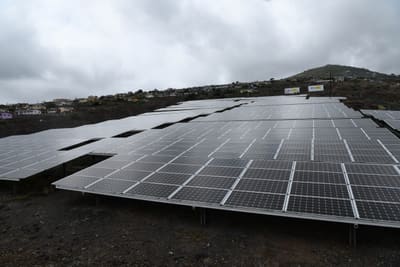
- Solar generation comes chiefly from the 500 kWp solar farm on the former rifle range at Half Tree Hollow, commissioned in 2015, alongside rooftop panels including our Jamestown offices. Solar supplies around 8% of the island's electricity.
Together, wind and sun supplied 10.7% of the island's electricity in 2024/25. See Renewable energy for the figures and our plan to reach more than 80%, starting with a new solar farm and battery at Rifle Range.
Because renewable output cannot be scheduled, the Power Station must always be able to pick up the whole island load at short notice. This is why the diesel plant matters even in a good wind year, and why generating capacity is sized against peak demand rather than average demand.
The generation mix for each year is published in our utility statistics.
Distribution
Generation feeds an island-wide 11kV distribution network, stepped down through local transformers to the 240V supply at your property. The network covers every inhabited district, much of it overhead line across steep and exposed terrain.
Two consequences follow from that terrain:
- Weather affects supply. High wind, salt spray and vegetation contact are the most common causes of unplanned interruption.
- Fault-finding takes time. A fault on a long rural feeder has to be located before it can be repaired, which is why your report genuinely helps: several reports from different places narrow the search quickly.
Current and planned interruptions are listed on the supply status page.
Where our responsibility ends
We are responsible for all service lines and cable up to and including your meter and service cut-out fuse. Everything beyond the meter (your consumer unit, wiring, sockets and appliances) belongs to the property owner.
If your breaker trips repeatedly and disconnecting appliances does not fix it, the fault is most likely inside the property and you will need a licensed electrician. If your electrician confirms the problem is on our side, tell us.
Safety
Treat every fallen wire as live. Stay at least 10 metres away, keep others back, never attempt to move it, and never step into water near it.
Call 999 if anyone is hurt or in immediate danger. Then call 22255 in working hours or 22602 out of hours so we can make the network safe.
Before planting trees or erecting anything tall near overhead lines, read our planting guidance. Trees growing into conductors are a recurring cause of both outages and serious injury.
Saving electricity
Generation on a small island is expensive, so the cheapest unit is always the one you do not use.
- Keep your fridge at or below 5°C and your freezer at or below −18°C. Colder than that costs more without keeping food any safer.
- Fit LED lamps. They use roughly a tenth of the electricity of filament bulbs for the same light.
- Switch off at the wall rather than leaving equipment on standby.
- Run washing machines with full loads, at the lowest effective temperature.
- Check your meter regularly. A sudden rise with no change in habits usually means a fault or a failing appliance.
Your tariff and standing charge explain how these savings translate into your bill.